Block Buddies
NeuroNest · A free number game for children about 4 to 8
Every number is built from blocks a child can see and count. Type a sum and the blocks act it out, then take any number apart to see its hundreds, tens and ones.
Drag or swipe sideways to turn
One number, many shapes.
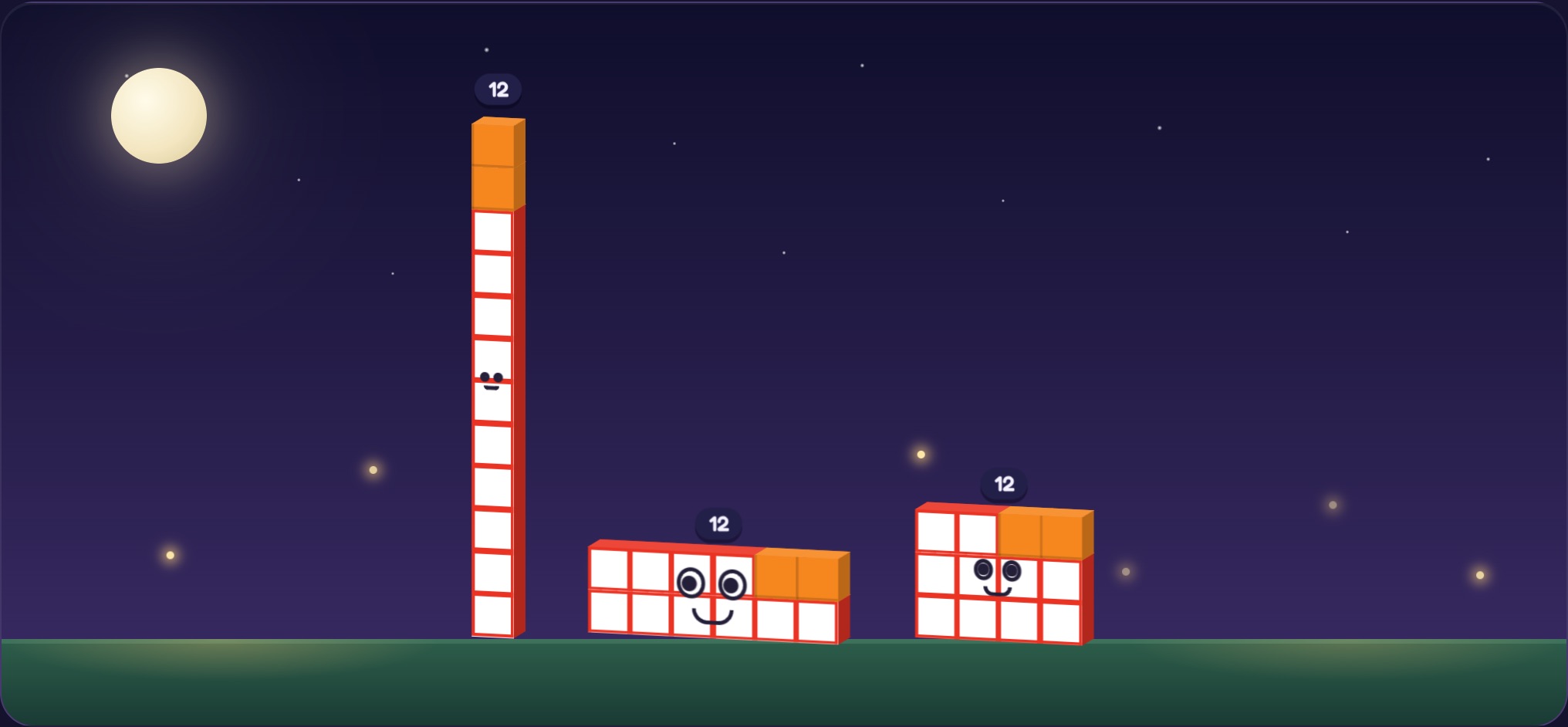
Start in twenty seconds.
- Press Play. The game opens in the moonlit garden, with a short guide that shows the first three moves.
- Type a number, then a sum. Try 3 × 4 and press equals. The buddies build the answer as three rows of four.
- Tap any buddy. It comes apart into hundreds, tens and ones. Then try Reshape, or a quiz from the Start here row.
Short sessions are a good rhythm: ten to fifteen minutes, with a grown-up nearby to ask a question or two. The game works on a tablet, phone or computer, and needs no sign-up.
How it works.
Block Buddies gives every number a body. The number 47 is not just a symbol; it is four rods of ten and seven single cubes, standing in a garden. Three simple rules let a child read any buddy at a glance.
Color is the digit
Each digit has its own color.
1 is red, 2 orange, 3 yellow, 4 green, 5 light blue, 6 indigo, 7 a rainbow, 8 pink and 9 three shades of grey. A lone ten is white with a red edge. So 453 shows green hundreds, light blue tens and yellow ones, at any size.
Texture is the place
Ones, tens and hundreds look different.
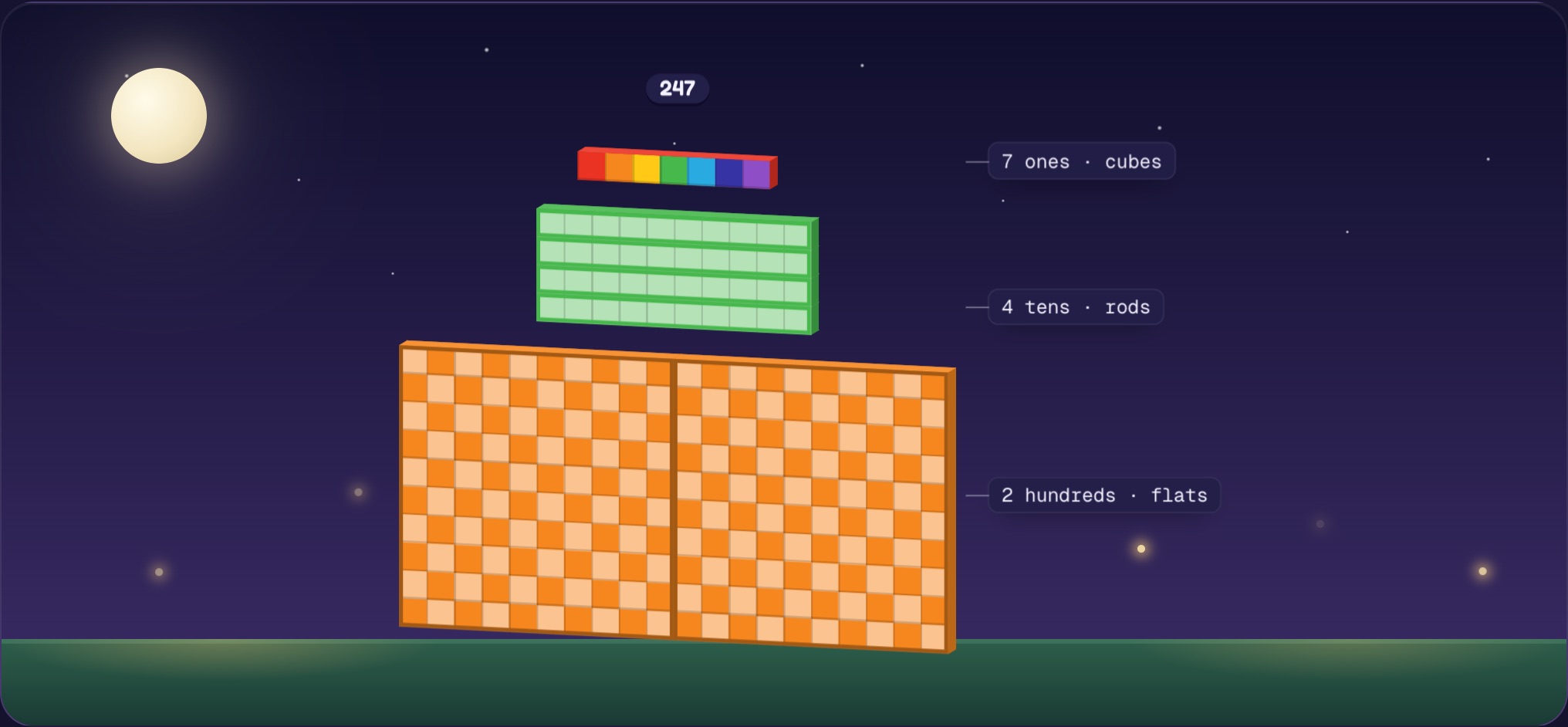
Ones are solid cubes. Tens are rods with a bright edge. Hundreds are checkered flats. The pattern starts again at the thousands, the same way the commas do.
Shape is the math
The shape tells the story.
Multiplying builds rows, so 3 × 4 stands as three rows of four. Square numbers stand as squares, and step numbers like 15 and 21 stand as staircases called step squads. Reshape any buddy and it is still the same number.
A calculator that shows its work.
- Type a sum. The calculator works like any other, with big keys a small hand can hit.
- Press equals. The buddies do the math: adding slides them together, taking away cancels blocks, multiplying builds rows, dividing shares them out, fractions included.
- Hear it and read it. The screen gives the answer, its name in words, and what it is made of, such as “2 tens · 4 ones”.
Take any number apart.
Tap a buddy and it comes apart like the objects on our home page. Each piece lifts away with a label, so a child can see that 247 really is two hundreds, four tens and seven ones. Tap again and it clicks back together.
Three places to play.
Garden
Build and explore.
The calculator, the garden of buddies, Reshape, and a drawer of extras for fractions and giant numbers.
Quiz
Nine short quizzes, in order.
They are grouped as Start here, Next and Stretch, from quick looks and bigger or smaller up to the number line and times tables.
Sky
A light for everything you do.
Each achievement lights a star in a night sky, and a few lights stay dark until a hidden number is found.
Secret numbers to find.
More than thirty famous numbers are hiding inside Block Buddies, from π and the golden ratio to 1729, the taxicab number. Some appear when you type their names. Some turn up by surprise. Some only show themselves when a sum lands right on them. Every one a child finds lights a secret star in the Sky, with a short, true fact about why that number is special.
How it helps children learn.
See it first
Quantity before symbols.
Children understand an amount long before the numeral that names it. Block Buddies moves from the blocks, to a picture, to the written number, the order many math teachers use in the classroom.
The right level
It grows with the child.
Two right answers in a row makes the next question a little harder. A miss makes it a little easier. Questions a child missed come back in a later round for another try.
Kind mistakes
Every miss explains itself.
A wrong answer gets one plain sentence, such as “7 tens beat 4 tens, so 74 is bigger.” No buzzers, no lost lives, just the reason.
Before reading
Questions read aloud.
Early levels read every question out loud, and a speaker button repeats it anytime, so children who are not reading yet can still play.
- Seeing small amounts at a glance
- Counting and comparing
- Place value
- Number bonds
- Odd and even
- Halves and doubles
- Adding and taking away
- Times tables as arrays
- Factors and primes
- Square and step numbers
- The number line
- Early fractions
Block Buddies is a small sample of a larger game we are building. It is made to be played alongside a grown-up and talked about, not to replace a teacher.
Questions to ask while they play.
“Is it still the same number? How do you know?”
“Which one is bigger, and by how much?”
“Can you build it another way?”
Talking through the answer matters more than getting it right the first time.
Inspired by great teaching. Made by us.
The best children’s math programs proved a simple idea: numbers make sense when children can see them. Block Buddies starts from that idea and builds everything else itself.
The characters, faces, names, artwork, sounds and code are designed and built in house at Castilloworks. We do not use any show’s characters, names, episodes, music or artwork, and Block Buddies is not connected to, or endorsed by, any show, studio or broadcaster. The math itself, place value, number bonds and times tables, belongs to everyone.
Private, and made for every child.
Private
Nothing leaves the device.
No accounts, no ads and no sign-up. Progress is saved only in the browser on the device your child uses, and the game does not send what your child does anywhere.
Works anywhere
Tablet, phone or computer.
It keeps working offline once it has loaded, and it can be added to a home screen like an app.
Accessible
Built for more ways to play.
Keyboard controls, screen reader announcements, spoken numbers, a day and night look, and calmer motion for children who prefer less movement.